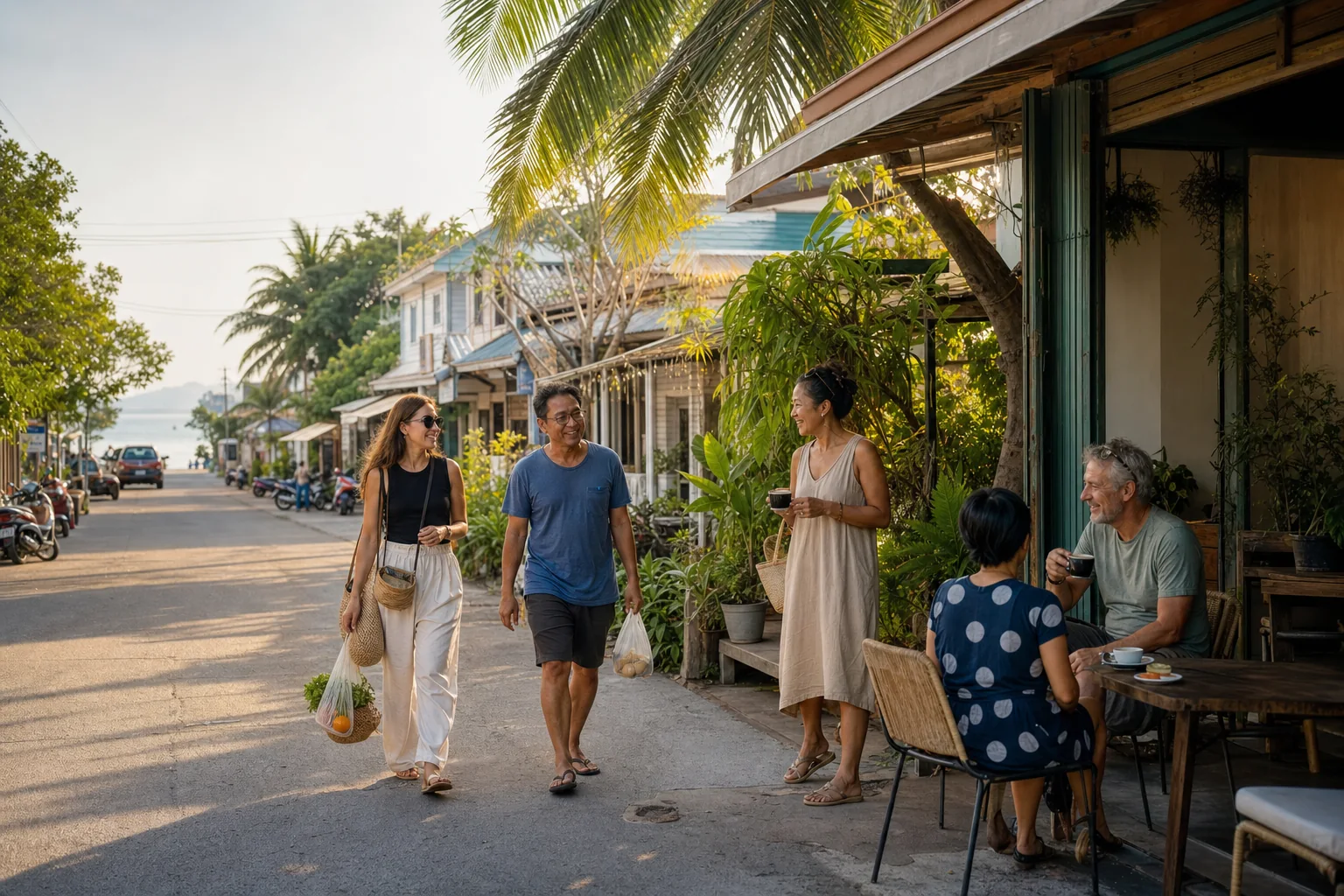
Hua Hin is often sold as a royal beach resort, a weekend escape from Bangkok, or a checklist of attractions. That version is true, but it is incomplete. The better Hua Hin, especially for guests staying near Khao Takiab or planning a longer visit, is found in the daily places where residents, retirees, Thai families, remote workers and returning expats actually spend time. This guide focuses on local markets, food courts, quiet seaside parks, practical neighbourhoods, everyday cafes, beach routines and the advantages that make Hua Hin one of Thailand's easiest coastal cities to enjoy slowly.
Hua Hin is often sold as a royal beach resort, a weekend escape from Bangkok, or a checklist of attractions. That version is true, but it is incomplete. The better Hua Hin, especially for guests staying near Khao Takiab or planning a longer visit, is found in the daily places where residents, retirees, Thai families, remote workers and returning expats actually spend time. This guide focuses on local markets, food courts, quiet seaside parks, practical neighbourhoods, everyday cafes, beach routines and the advantages that make Hua Hin one of Thailand's easiest coastal cities to enjoy slowly.
This article deliberately avoids monument-led sightseeing. It highlights local-life places and habits that make Hua Hin relevant for travelers who want comfort, authenticity and a reason to stay longer.
Why Hua Hin is better when you stop chasing attractions
Many first-time visitors arrive with a list of famous names. They want the beach, the train station, the night market, a temple viewpoint and one or two day trips. Those can be pleasant, but they do not explain why so many people return to Hua Hin for months, seasons or entire retirement chapters. The city becomes more convincing when it is treated as a place to live for a while, not only a place to consume in two days.
The local version of Hua Hin is less dramatic and much more valuable. It is the morning walk before the sun becomes strong, the food court where Thai families and expats sit at neighbouring tables, the market stall remembered by name, the practical mall errand that does not ruin the day, the shaded park bench by the sea, and the short ride back to a quiet resort base. That is the Hua Hin that creates loyalty.
For Baan Sunanta guests, this matters because the resort sits in the Khao Takiab and Nong Kae side of the city. It is close enough to reach the active parts of Hua Hin but calm enough to make daily life feel residential. A visitor who uses the city like a local will understand the value of pool-villa and apartment space, private roof gardens and practical routines much faster than a visitor who only follows a tourist map.
The first local circuit: Khao Takiab, Nong Kae and slow mornings
Start close to the resort rather than rushing to the center. Khao Takiab and Nong Kae give Hua Hin a softer rhythm: small cafes, beach roads, seafood signs, residential lanes, condo buildings, market stops, temple bells in the distance and enough everyday services to make a long stay feel simple. It is not isolated, but it does not demand constant activity.
The best morning plan is ordinary. Walk early, drink coffee somewhere independent, buy fruit or snacks, return before the heat builds, swim, then decide whether the day needs anything bigger. This is not a wasted morning. It is the habit that makes Hua Hin feel generous. Locals and expats do not try to turn every day into a tour; they protect the part of the day that feels fresh.
Guests comparing neighbourhoods should read the Khao Takiab stay guide before booking. The article explains why calm access, room size, outdoor space and return-home comfort can matter more than being closest to the busiest central strip. That logic is especially strong for couples, families and anyone staying more than a weekend.
Food courts are the real social engine of Hua Hin
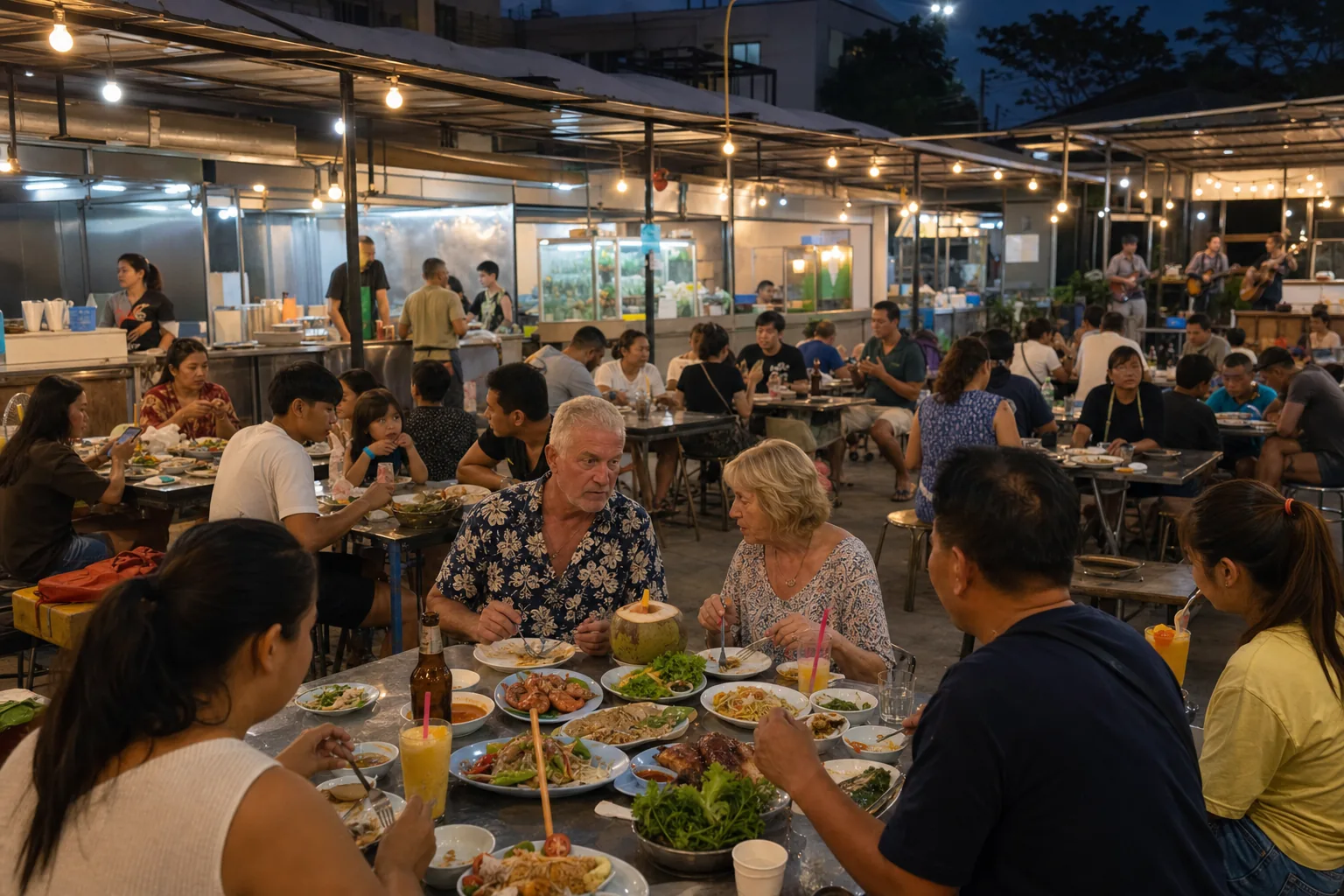
A polished beachfront restaurant can be beautiful, but the places that reveal Hua Hin most clearly are often food courts and practical eating streets. Baan Khun Por on Soi 88 is a useful example of the type of place this guide values: relaxed, mixed, easy to repeat, informal enough for families, and familiar to residents who want choice without ceremony. The point is not that every traveler must go to one exact address. The point is to understand the category.
Food courts work because Hua Hin is socially mixed. Thai families, Bangkok weekenders, foreign retirees, golfers, remote workers and returning seasonal guests may all want different food at the same table. One person orders seafood, another wants grilled pork, another wants noodles, another wants something Western, and no one has to turn dinner into a formal negotiation. That is a real advantage for groups.
For actual travel usefulness, this is a stronger recommendation than another list of attractions. People looking for where locals eat in Hua Hin often need a pattern, not a trophy. Look for busy but calm tables, repeated local customers, reasonable turnover, visible cooking, flexible ordering and easy transport back to the room. If a place makes dinner effortless, it belongs in the itinerary.
Markets to use, not just photograph
Local markets are not only photo stops. They are how a visitor learns the price of fruit, the timing of dinner, the difference between a tourist souvenir and a household purchase, and the way Hua Hin residents organize ordinary life. Chatchai Market is useful for fresh produce and the old-town market rhythm. Pae Mai is better understood as an evening social market, especially when the goal is inexpensive food, browsing and local energy.
The practical rule is simple: go with a purpose. Buy mango, herbs, breakfast fruit, a snack for the room, sandals, a phone cable or something that would actually improve the stay. Travelers who only look for content miss the real value. A market becomes more meaningful when it supports the next morning, the beach bag, the roof-garden evening or the kitchen routine in the apartment.
This connects directly with long-stay planning. A month in Hua Hin is not made of attractions. It is made of weekly shopping, laundry, familiar food places, walking habits, medical errands, cafe work sessions, quiet dinners and reliable transport. Markets help guests test whether the city fits their normal life, not only their holiday mood.
Queen's Park 19 Rai and the health advantage of the city
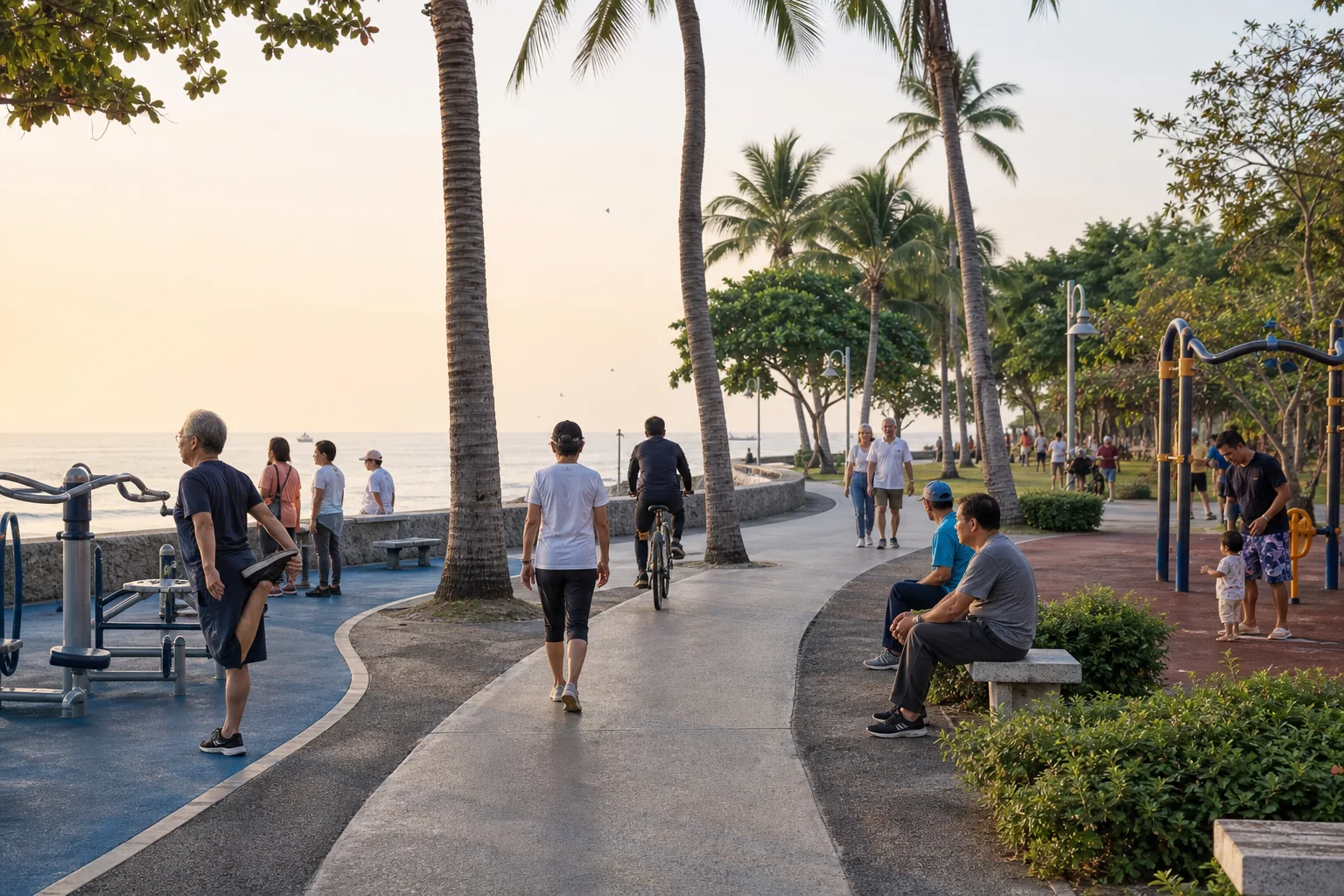
One of Hua Hin's underrated advantages is that healthy daily routines are easy. A seaside public park such as Queen's Park 19 Rai gives the city something many beach resorts do poorly: a shared outdoor place that is not only for spending money. Morning walkers, children, older residents, cyclists, light exercise groups and expats can all use the same space without turning it into an attraction.
For visitors, this changes the tone of the trip. Instead of waking up and asking what to book, the day can begin with movement, sea air and shade. That is especially valuable for older travelers, long-stay guests and families who need routines that are low cost, low pressure and easy to repeat. A park also makes Hua Hin feel less like a strip of hotels and more like a city with civic habits.
The lesson for Baan Sunanta guests is to choose accommodation that supports this rhythm. A morning outside, a swim, a simple breakfast and a slow return to a private terrace or roof garden can feel more luxurious than another packed excursion. The facilities page and roof-garden page are useful internal links because they explain how the resort side supports the city routine.
Why expats choose Hua Hin for more than the beach
The expat appeal of Hua Hin is practical before it is romantic. Bangkok is reachable, but the daily tempo is lighter. There are hospitals, clinics, dentists, gyms, golf courses, supermarkets, markets, cafes, international restaurants, Thai food, schools, transport options and a large enough foreign community to make settling in less lonely. The city feels easier than a remote island and calmer than the capital.
That balance attracts different profiles: retirees who want health access and calm, couples testing Thailand for a season, digital workers who do not need Bangkok every day, families seeking a softer holiday base, golfers, wellness travelers and Bangkok residents who want a reliable weekend escape. Hua Hin's strength is not one spectacular feature. It is the way many ordinary features work together.
Visitors can use this expat logic without pretending to be residents. Stay long enough to repeat routines. Try a normal supermarket run. Eat in places where people recognize regulars. Walk the same morning route twice. Spend one afternoon doing nothing at the resort. When a destination still feels good without sightseeing, it has real staying power.
Where to go when you want local relevance
Use this list as a direction, not a rigid checklist. For morning life, explore Khao Takiab and Nong Kae streets near the resort, then come back before the sun becomes heavy. For food, try a relaxed food court such as the Soi 88 style, then compare it with a smaller local restaurant on another night. For markets, use Chatchai for fresh-market context and Pae Mai for an evening market with resident energy.
For outdoor routine, choose a seaside park morning instead of another paid attraction. For practical errands, do not dismiss Market Village or Bluport simply because they are malls. Locals and expats use them for real reasons: groceries, banking, pharmacies, coffee, repairs, rain cover, air conditioning and meeting points. Practicality is part of travel quality, especially in a hot coastal city.
For a quieter evening, return to Khao Takiab rather than extending the night just because the center is active. The advantage of a boutique resort base is the ability to leave the crowd when the useful part of the outing is complete. A good Hua Hin itinerary should have exits, not only entries.
The advantages Hua Hin offers tourists who might stay longer
Hua Hin is easy to recommend because it combines beach atmosphere with urban convenience. Travelers get sea air, seafood, golf, markets, wellness options and a slower pace, but they do not lose access to medical care, shopping, transport, internet, restaurants or Bangkok connections. That mix lowers the risk of choosing the city for a family holiday, a remote-work experiment or a seasonal stay.
The city is also emotionally accessible. It does not require the same intensity as Bangkok, and it does not ask visitors to give up comfort in order to feel local. A guest can eat street food one night, cook simply the next morning, work online for a few hours, swim, take a park walk, visit a market and still be back in a private outdoor space before evening heat fades.
That is the strongest tourism argument: Hua Hin lets visitors build a life-sized holiday. It can be romantic without being isolated, family-friendly without being childish, useful for retirees without feeling closed, and relaxed without being empty. The more a traveler values comfort, repeatability and calm access, the more persuasive the city becomes.
How to plan a three-day local-style stay
Day one should be arrival-focused. Confirm transfer timing through the location guidance, unpack, swim, eat nearby and keep the first night modest. Avoid the mistake of using arrival day to prove that the trip has started. A calmer first evening improves the whole stay.
Day two can carry the local circuit. Start early in Khao Takiab or a seaside park, rest during the heat, use the pool or roof garden, then go to a food court or market in the evening. This creates variety without exhausting the group. Families, older guests and couples all benefit from the same structure because it respects weather and energy.
Day three should answer the booking question. If Hua Hin still feels good during a normal breakfast, a market errand and a quiet hour at the resort, consider whether a longer stay would work. Open the reservation request page with specific questions about dates, unit type, current rates, inclusions and long-stay fit. Good travel decisions are easier after a real rhythm has been tested.
Why Baan Sunanta fits this version of Hua Hin
Baan Sunanta fits this article because the property is not trying to compete with giant hotel spectacle. Its value is quieter: private pool-villa comfort, an executive apartment, outdoor space, roof gardens, practical facilities and a Khao Takiab location that suits slower daily routines. That is exactly what a local-style Hua Hin guide needs as a base.
A traveler who wants loud nightlife at the door may choose differently. A traveler who wants space, privacy, a calm return point and access to real city routines will understand the property faster. The article should therefore guide readers naturally toward accommodation, long-stay options, guest facilities, activities and monthly rental planning.
The best outcome is simple: a visitor reads the article, sees Hua Hin as more than a tourist stop, imagines a daily routine, and understands why staying near Khao Takiab can make the city more enjoyable. That is stronger than selling another attraction. It sells the possibility of belonging for a few days, a month or a season.
Frequently Asked Questions
What are the best non-touristy places in Hua Hin?
Start with local-life places: Khao Takiab and Nong Kae mornings, Chatchai Market for fresh-market context, Pae Mai for evening market energy, a Soi 88 style food court such as Baan Khun Por, Queen's Park 19 Rai for exercise and sea air, and practical everyday stops such as local cafes or malls when the weather is hot.
Is Hua Hin good for expats and long-stay travelers?
Yes. Hua Hin works well for many long-stay guests because it combines beach life with hospitals, supermarkets, markets, restaurants, golf, fitness, transport and a large resident community. It feels calmer than Bangkok while remaining practical for everyday life.
Where should Baan Sunanta guests focus first?
Begin close to Khao Takiab and Nong Kae. A quiet morning walk, a market stop, a swim and a relaxed dinner will teach more about the stay than rushing into central Hua Hin immediately.
How many days do you need to feel the local side of Hua Hin?
Three days are enough to test the rhythm, but a week is better. The city becomes more persuasive when you repeat simple routines: morning walks, food courts, markets, pool time, errands and quiet evenings.
Useful context checked June 25, 2026: the Tourism Authority of Thailand presents Prachuap Khiri Khan as accessible from Bangkok and less crowded than many resort areas; Hua Hin Today documents Queen's Park 19 Rai, Baan Khun Por and night-market options including Pae Mai.